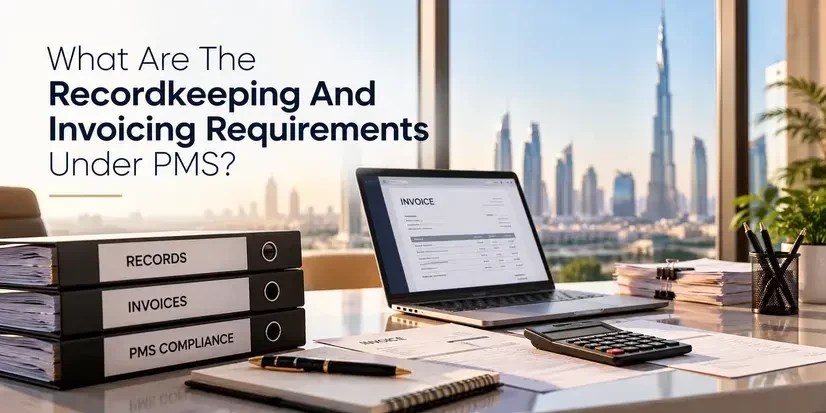
What Are the Recordkeeping and Invoicing Requirements Under PMS
Managing tax compliance in the UAE requires a thorough understanding of current VAT frameworks; and today, none of it is more critical for resellers than the Profit Margin Scheme (PMS).
If you deal in pre-owned luxury goods, second-hand cars, or vintage collectibles in the UAE, charging standard 5% VAT on your full selling price can quickly wipe out your profit. And if your inventory is often sourced from private individuals who can’t issue tax invoices, there’s no input VAT to claim back; which means that with standard VAT the same item will get taxed twice!
The Profit Margin Scheme (PMS) solves this by letting eligible resellers pay VAT strictly on their net profit margin rather than the total sale value. It’s a huge financial relief, but it comes with a major catch: your invoicing and recordkeeping must be up to date.
Under the Federal Tax Authority’s official guidance (VAT Guide VATGPM1), applying the scheme isn't just about calculating lower tax; it requires strict documentation rules. One small mistake on a customer invoice will instantly disqualify the transaction and force you to pay 5% on the full selling price.
This is a practical, straightforward look at the mandatory recordkeeping and invoicing rules under the Profit Margin Scheme, and how to keep your business fully compliant.
What Is the Profit Margin Scheme?
Simply put, the Profit Margin Scheme is an optional way to handle VAT if you buy and resell pre-owned goods, antiques, or collectors' items in the UAE. Under standard VAT rules, you pay tax on the full selling price. Under PMS, you pay VAT only on the markup; that is the profit you make between what you bought the item for and what you sell it for.
Here is the twist that makes recordkeeping so critical: the burden of proof is entirely on you. To use the scheme legally, you must satisfy specific FTA rules:
- Proof of Prior UAE VAT: You must hold concrete documentation proving the item was taxed in the UAE at least once in its lifetime (such as an original tax invoice from when it was sold new, or a scheme invoice from the previous seller).
- The "No Separate VAT Line" Rule: You can never show a separate VAT amount on the customer's invoice. Break it out, and the FTA instantly reclassifies the deal as a standard sale, forcing you to pay 5% on the full selling price out of pocket.
- Strict Stock Tracking: You have to maintain an itemized stock register linking every single purchase receipt to its corresponding resale invoice.
The Federal Tax Authority's guidance (VAT Guide VATGPM1) makes it clear that while PMS can save your business substantial tax money, your invoicing and bookkeeping must be setup tightly before you issue a single invoice.
What Are Recordkeeping and Invoicing Requirements Under this?
PMS invoices don't show a separate tax breakdown, so the Federal Tax Authority (FTA) can't verify your VAT from the invoice alone. Your internal records have to do that job. If they fall short in an audit, the scheme will not apply for those sales, and then you'd owe 5% VAT on the full selling price, plus penalties.
1. Get the Invoice Right
Your invoice needs to be titled "Tax Invoice" and include your TRN, the buyer's details, a description of the item and the total payable in AED. You'll also need to print a declaration, such as "VAT charged under the UAE Profit Margin Scheme - Article 29 of Executive Regulation."
What you leave off matters just as much. Ensure that you do not type a separate VAT amount, the 5% rate or your margin calculation on your customers’ invoice(s).
2. Self-Invoice When You Buy from Private Sellers
When you buy pre-owned stock from an unregistered individual, there's no tax invoice to rely on, so you create your own proof. Issue a Self-Invoice or Purchase Declaration and then get the seller’s signature on the same.
This should have:
- Seller’s full legal name, contact details, and Emirates ID/Passport number.
- Detailed item description (brand, model, serial/VIN number).
- Exact purchase date and amount paid in AED.
- Physical or verified digital signature of the seller.
If possible, keep proof that the item was originally taxed in the UAE after 1 January 2018 (such as the original UAE retail receipt or a seller declaration.)
3. Maintain a Stock Book for All Items
Article 29 requires that you maintain an itemised Stock Book that will tie each purchase to its eventual sale.
- Item Identifier: Unique stock number, serial number, IMEI, or VIN.
- Purchase Details: Purchase date, seller name/TRN, purchase invoice reference, and purchase price (AED).
- Sale Details: Sale date, buyer name/TRN, sales invoice reference, and final sale price (AED).
- Tax Extraction: The calculated profit margin (AED) and extracted VAT amount.
If an item sells at a loss, the margin is zero and no VAT is due, but you can't offset that loss against profits on other items. Think of your Stock Book as your main line of defence in an audit.
4. Keep Your Records ready
Hold on to your stock registers, purchase declarations, sales invoices and bank statements for at least 5 years for VAT purposes, and 7 years for Corporate Tax.
These same records are what you'll draw on each period when preparing your VAT return, so keeping them complete and up to date makes filing easier as well as protecting you in an audit.
Why Choose CDA?
The UAE Profit Margin Scheme (PMS) is one of the most effective tax mechanisms for pre-owned goods resellers, allowing you to pay 5% VAT on the actual margin rather than your full revenue. However, any financial benefits that come from the Federal Tax Authority, come with zero tolerance for compliance errors. To safely ensure compliance with the PMS scheme, ensure that all your accounting workflows , stock tracking systems, and all invoicing templates are able to withstand strict FTA audits with professional assistance from the experts of CDA.
For a thorough review of your existing systems, contact CDA’s experts for a free consultation!

Mitesh Maithia
Tax Manager
Mitesh is a Tax Professional with expertise in direct, indirect, and international taxation, including transfer pricing, since 2018. Passionate about making complex tax matters simple, he shares insights to help businesses stay compliant and forward-looking.