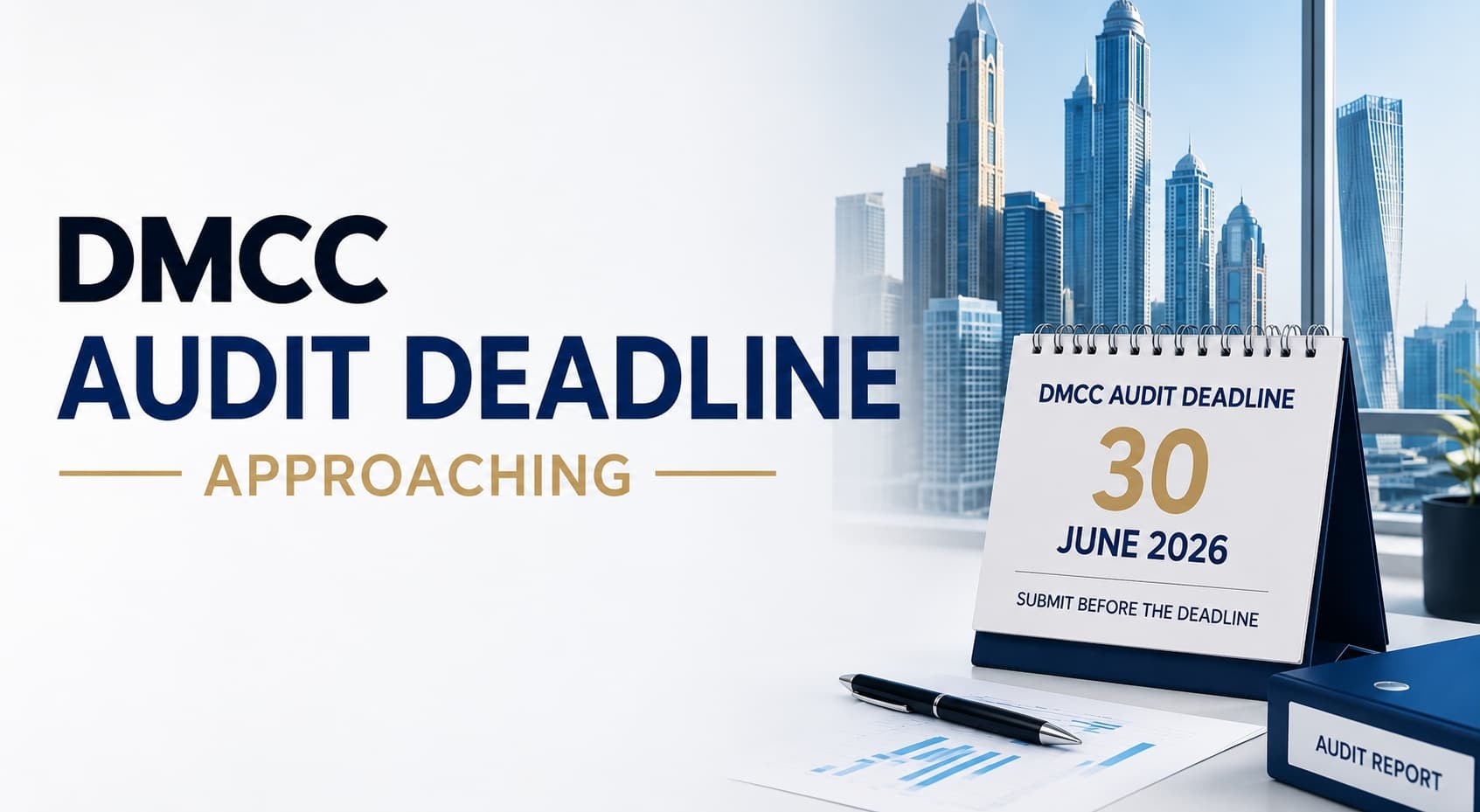
DMCC Audit Deadline Approaching: Why Businesses Should Act Before June 30, 2026
The Dubai Multi Commodities Centre (DMCC) stands as one of the UAE's most respected free zones, hosting tens of thousands of registered entities across trading, consultancy, technology, and financial services. As with all free zones governed under UAE regulatory frameworks, DMCC imposes firm financial reporting obligations on every company operating under its licence. The most significant of these obligations is the preparation and submission of annual audited financial statements, a requirement that far too many businesses still approach without adequate planning.
With June 30, 2026, now only days away, any company that has yet to initiate its audit is already in a difficult position. This article provides a practical overview of the requirements, including eligibility, required documentation, compliance considerations, and the benefits of engaging a qualified auditor to facilitate a smooth submission.
Why Annual Audited Financial Statements Matter
An audit serves a purpose well beyond satisfying a regulatory requirement. Audited accounts verify the accuracy of financial records, demonstrate compliance with applicable standards, underpin corporate tax reporting, support licence renewal applications, and signal credibility to banks, investors, and commercial partners. Each of these functions matters on its own. Together, they make audited financial statements one of the most operationally significant documents a company produces each year.
Since the UAE introduced its corporate tax framework, audited financials have become even more consequential. They form the primary document on which tax positions are built and defended. Financial institutions require them before extending credit. International counterparties treat them as a baseline measure of transparency. Within the DMCC specifically, they feed directly into the licence renewal process, meaning a missed or deficient audit can interrupt business continuity in ways that extend far beyond a single penalty.
Who Needs to Submit Audited Financial Statements?
Across the board, DMCC registered entities are generally required to submit annual audited financial statements as part of their regulatory obligations, and this applies regardless of company size, revenue level, or the nature of business activity. The requirement is broad by design.
Trading companies, consultancies, service businesses, technology firms, holding entities, manufacturing operations, and branch offices of foreign companies registered within the DMCC all fall within scope. There is no minimum turnover threshold that reliably waives the obligation. Any company holding a DMCC licence should proceed on the assumption that it is required to comply and take qualified professional advice if there is any genuine uncertainty about its specific position.
Key Dates - DMCC Audit Cycle
| DMCC Audit Cycle Milestone | Details |
| Financial Year End | 31 December 2025 |
| Standard Audit Submission Deadline | 30 June 2026 |
| Extended Deadline (If Granted by DMCC) | 30 September 2026 |
| Submission Method | Through the DMCC Member Portal |
| Audit Certificate Issuance | Issued after successful review and approval of the audit submission by DMCC |
Need Help with Your DMCC Audit? Speak to Our Experts
Documents Required for the DMCC Audit
The most frequent reason audits stall or produce qualified reports is disorganised documentation at the point of engagement. Companies that keep structured records throughout the year are better prepared when the audit begins. The documents an auditor will need typically include the following:
Accounting Records
A complete general ledger, chart of accounts, and trial balance covering the entire financial year.
Transaction Records
Sales invoices, purchase documentation, bank statements, payment receipts, and reconciliation schedules.
Payroll Records
Salary registers, employment agreements, and records of end-of-service accruals where relevant.
Fixed Asset Register
A current schedule covering all capital assets, including acquisition dates, original cost, accumulated depreciation, and net book value.
Drafted Financial Statements
A balance sheet, income statement, cash flow statement, and accompanying notes prepared in advance of the auditor's fieldwork.
Contracts and Legal Documents
Significant commercial agreements, lease arrangements, shareholder documentation, and any material related-party transactions.
Gaps in invoices, unreconciled bank accounts, and missing contracts are the most common causes for audit delays. Businesses that have not started organising their records should make this their priority.
The Risks of Last-Minute Audit Preparation
The fallout from missing the June 30 deadline goes beyond a single fine. Late submissions can lead to financial penalties, trigger regulatory notices, hold up licence renewals, and invite closer scrutiny from the authority on future filings. In more serious cases, restrictions on business activities may follow. There is also an issue that companies often fail to anticipate. Reputable audit firms get fully booked well ahead of major deadlines. A business approaching an approved firm in the second or third week of June may simply find that no qualified team is available to complete the engagement in time, leaving the deadline missed regardless of intent or budget.
Compressed timelines also carry internal risks. When documentation problems emerge during a last-minute audit, teams are forced to recreate months of records under pressure. The likelihood of errors finding their way into the final report rises sharply, and the auditor may have grounds for issuing a qualified opinion, which creates a separate compliance problem of its own.
How Professional Auditors Can Help Meet the Deadline
DMCC requires that audit reports be prepared by firms that appear on its approved auditor list. A report submitted from a non-approved firm will not meet compliance requirements, regardless of the quality of work behind it. This is a detail that catches some businesses off guard and should be confirmed before any engagement is signed. A qualified, DMCC approved audit firm does considerably more than produce a signed report.
Experienced auditors conduct a review to identify gaps in records and flag accounting treatments that need to be addressed before formal fieldwork begins. This step reduces the time taken to complete the audit and the number of queries raised. It also means that the final submission, including the audited financial statements, the independent auditor's report, and all required disclosures, arrives at the DMCC portal in a format that passes technical review without rejection. Firms with experience in the DMCC environment also understand how the authority's compliance expectations intersect with UAE Corporate Tax obligations, ensuring that the same financial statements support the free zone submission and the company's broader tax position simultaneously.
Act Now
Businesses that have not yet appointed a DMCC approved auditor should treat this as an immediate obligation. Even for a well-organised firm with clean records, the preparation phase covering reconciliation, financial statement drafting, and document assembly typically runs four to six weeks. For businesses with excellent bookkeeping, the timeline is longer. June 30, 2026, is a firm deadline. There is no benefit in delaying further.

Mitesh Maithia
Tax Manager
Mitesh is a Tax Professional with expertise in direct, indirect, and international taxation, including transfer pricing, since 2018. Passionate about making complex tax matters simple, he shares insights to help businesses stay compliant and forward-looking.